Anatomy of a Cognitive Debt
The Riemann hypothesis has been proved with the help of an artificial intelligence, and the proof is most likely correct. But mathematics exists to help us understand, and for now nobody understands this one.

In brief
- On November 20, 2026, Levent Alpöge, a mathematician at Anthropic, announced that he had found, together with Claude, a proof of the Riemann hypothesis and of its generalized version for Dirichlet L-functions.
- The proof exists only as a Lean library of about 17 million lines. The natural-language version produced by the model runs, according to the author, to more than 250,000 pages and has not been published.
- On November 21, the Lean and Mathlib communities certified that the statement is the right one and that the proof is correct, after checks with several independent kernels.
- Nobody, the author included, can yet explain why the proof works.
- It is the most extreme case of what in this article I call cognitive debt: the distance between what a community knows to be true and what that community is able to understand.
Prologue. A notebook in Göttingen
In 1859 Bernhard Riemann published a paper of just over eight pages on the number of primes less than a given magnitude. It was his only work in number theory, and it contained, almost in passing, the statement that would become the most famous problem in mathematics. Riemann wrote that it seemed “very probable” to him that all the nontrivial zeros of a certain function have real part equal to one half, and he added that he had set aside the search for a proof after a few fruitless attempts, because it was not needed for the immediate purpose of his work.
He died seven years later, at thirty-nine. His notes ended up in the library of the University of Göttingen, and for decades nobody read them carefully. Only in 1932 did Carl Ludwig Siegel, working through those disordered papers, find in them a highly refined asymptotic formula for computing the zeta function on the critical line, now known as the Riemann–Siegel formula. It showed that Riemann had computed some zeros numerically, and that he knew far more than he had written. For seventy years the mathematical community had been in debt to Riemann without knowing it, and that debt was repaid when someone had the patience, the skill and the time to reconstruct the thinking behind a few fragments of calculation.
I begin with this story because what is happening these days is its almost perfect reverse. Back then we had a deep intuition and very little writing. Today we have an immense body of writing, checked line by line by a machine, and no shared intuition. In both cases mathematics faces a credit of understanding that someone, sooner or later, will have to collect.
1. The problem in a few pages
If you already know the zeta function, you can skip this section. If you don’t, here you will find what you need to understand what has been proved and why it matters.
1.1 The zeta function and the primes
For every complex number with real part greater than 1, we define
Euler found the link with the primes in 1737, when he observed that, thanks to the unique factorization of the integers, the same series can be written as a product over all prime numbers:
This identity, the Euler product, is the bridge on which all of analytic number theory rests. On one side there is an analytic object, a function of a complex variable, which can be differentiated, integrated, continued. On the other there are the primes, which seem to be scattered along the number line with no visible rule.
1.2 The continuation and the critical strip
The series converges only for , but Riemann showed that extends to a meromorphic function on the whole complex plane, with a single simple pole at . The continuation satisfies a functional equation that links the values at to those at . In its symmetric form, with
the equation is simply written .
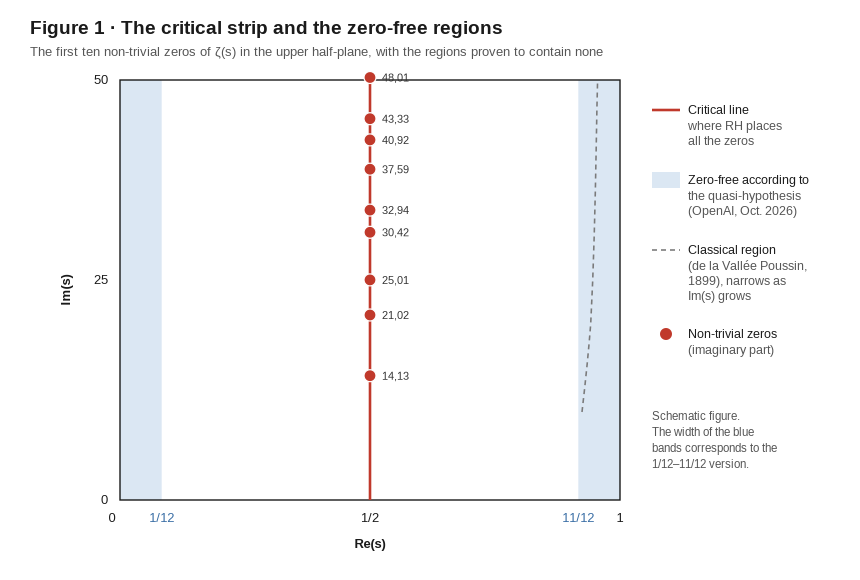
The zeros of fall into two families. The so-called trivial zeros lie at the negative even integers and come directly from the poles of the Gamma function. All the others, the nontrivial zeros, fall in the critical strip , and the functional equation arranges them symmetrically about the critical line .
Riemann hypothesis (RH). All nontrivial zeros of have real part equal to .
1.3 Why the zeros control the primes
The reason the position of the zeros matters to anyone studying the primes lies in von Mangoldt’s explicit formula. Denoting by the Chebyshev function, which counts primes and their powers with a logarithmic weight, for not a prime power we have
where the sum runs over the nontrivial zeros , taken in symmetric pairs. Each zero contributes an oscillating term of amplitude . If there were a zero with real part , the primes would deviate from their average behavior by an amount proportional to . If instead all the zeros lie on the critical line, the deviations are as small as they can possibly be. In 1901 von Koch proved that the Riemann hypothesis is equivalent to the estimate
where is the number of primes less than or equal to . In plain words, the Riemann hypothesis says that the primes are distributed as regularly as their nature allows, and that the error made in approximating them with the logarithmic integral does not exceed the square root, up to a logarithmic factor. It is a statement about the randomness of the primes as much as about their order, and that explains why it sits at the bottom of hundreds of theorems that begin with the words “assuming the Riemann hypothesis”.
1.4 The generalized version
In 1837 Dirichlet introduced functions analogous to zeta in order to study primes in arithmetic progressions. Given a Dirichlet character modulo , that is, a periodic and multiplicative function on the integers, one defines
The generalized Riemann hypothesis (GRH), probably first formulated by Adolf Piltz in 1884, states that for every primitive character all the non-trivial zeros of lie on the line . The case of the trivial character gives back the original Riemann hypothesis. There are also broader generalizations, such as the extended hypothesis for the Dedekind zeta functions of number fields and the “grand” hypothesis for all automorphic L-functions. Peter Sarnak, in a lecture at Harvard in April 2026, remarked that he knew of no truly decisive consequences of the original hypothesis, and that the problem becomes interesting when you add the G. The result announced in November concerns precisely the G, at least in its form for Dirichlet characters.
2. A hundred and sixty-seven years of siege
2.1 Partial results
On the Riemann hypothesis we have made enormous progress, and yet we have always remained at an enormous distance from the goal.
In 1896 Hadamard and de la Vallée Poussin independently proved the prime number theorem, which is equivalent to the fact that does not vanish on the line . In 1899 de la Vallée Poussin obtained the first zero-free region, of the form
which becomes thinner and thinner as one climbs up the strip. The following century improved the shape of this region, with the methods of Vinogradov and Korobov, but never to the point of obtaining a strip of fixed width. This is exactly why the so-called quasi-Riemann hypothesis, that is, the existence of a such that there are no zeros with , remained open for over a century.
On the opposite side, people have asked how many zeros can be placed on the critical line with certainty. Hardy proved in 1914 that there are infinitely many. Selberg showed in 1942 that a positive proportion of them lie on the line. Levinson in 1974 went past one third, Conrey in 1989 got beyond two fifths, and later improvements have moved the value by a few tenths of a point in thirty years.
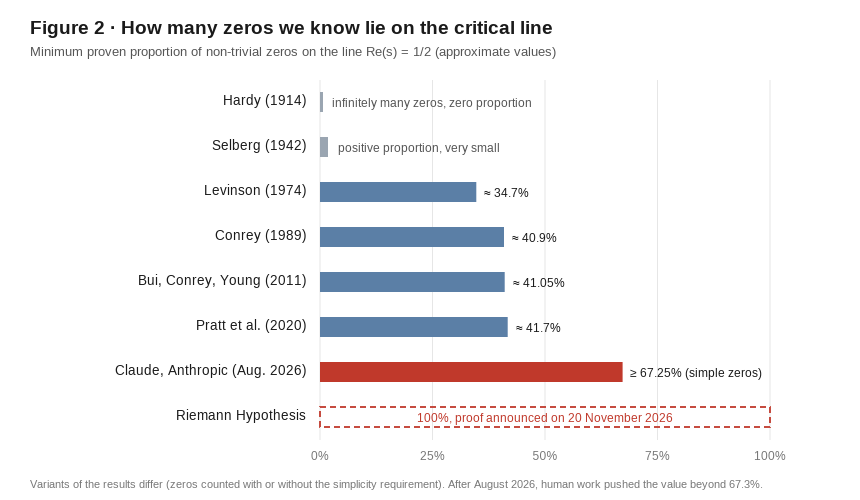
The jump in red in the figure happened in August 2026, and I will come back to it shortly. It is worth noticing the shape of the graph, because it alone tells the nature of the problem. For half a century the best analysts in the world gained tenths of a point with ever more refined techniques, the so-called mollifiers, and then an automated system moved the value by twenty-five points in a day and a half of computation.
2.2 The case of finite fields
There is one setting in which the analogue of the Riemann hypothesis has long been proved. For curves defined over finite fields, André Weil proved it in the 1940s, and Pierre Deligne in 1974 completed the proof of the Weil conjectures for varieties of any dimension. In 1969 Sergei Stepanov found a much more elementary proof for curves, based on a simple and powerful idea. One builds an auxiliary polynomial that vanishes with high multiplicity at all the points one wants to count. Since a polynomial of degree cannot have too many zeros counted with multiplicity , the number of points turns out to be bounded by about , and by choosing the parameters well one gets exactly an error of the order of the square root of the size of the field.
This detail, which may look like erudition, is the declared starting point of Alpöge’s proof. Over the integers the notion of multiplicity has no direct analogue, and this is precisely one of the reasons why, for decades, the techniques of finite fields never carried over to number fields.
2.3 Numerical verification
The problem has also been hammered at on the computer. The page of the Clay Mathematics Institute reports that the hypothesis has been verified for the first ten trillion zeros. No mathematician has ever considered this evidence a proof, because theory teaches that phenomena tied to these problems can show up at astronomical magnitudes, but the evidence helped create an almost unanimous consensus that the hypothesis was true. People took it for true and built on top of it.
3. 2026, chronicle of an anomalous year
The November proof does not come out of nowhere. It is the latest episode in a sequence that began in the summer, in which the major artificial intelligence labs started producing results on open problems of the first rank at a pace nobody had predicted.
- July
- Alpöge and Claude Fable 5 find a counterexample to the Jacobian conjecture in dimension 3
- August
- Claude raises the proportion of simple zeros on the critical line to over 67%
- Start of the formalization of Fermat in Lean
- September
- Sep 4 Anthropic publishes Fermat in Lean, 13 million lines in 11 days
- Sep 8 OpenAI announces finite-time blow-up for forced Navier-Stokes
- Sep 11 25 Fields medalists sign "A Severe Misalignment of AI in Mathematics"
- October
- Oct 6 OpenAI releases 722 papers, including the quasi-Riemann hypothesis
- November
- Nov 12 Buzzard publishes the four questions for checking AI-generated Lean code
- Nov 19 Anthropic lists on the Nasdaq
- Nov 20 Alpöge announces RH and GRH in Lean. The same day Vakil circulates Masullo's human draft
- Nov 21 Lean and Mathlib certify the statement and the proof
A few of these steps deserve a comment, because each one sheds light on a different aspect of the problem I want to discuss.
The Jacobian conjecture (July). Formulated by Keller in 1939, it asked whether every polynomial map from to itself with a nonzero constant Jacobian determinant is invertible, with a polynomial inverse. Alpöge, working with Claude Fable 5, found in dimension three a map with constant Jacobian determinant that is not injective. The counterexample takes a few lines, anyone with a computer algebra system can check it in a second, and within a few days Speyer gave a geometric explanation for it. This is a case of zero cognitive debt. The machine found the object, and humans understood it almost immediately.
The 67 percentage points (August). Anthropic reported that a staff member with no mathematical training had asked an unreleased version of Claude to make a serious attempt at the Riemann hypothesis. The model did not prove it, but it raised the proven proportion of simple zeros on the critical line from about 41.6% to over 67%, coordinating around sixty sub-agents and producing tens of millions of tokens in a day and a half. The result was formalized in Lean and checked by internal and external mathematicians, and within a few weeks several human papers picked it up, simplified it and improved it. Here too the debt was repaid quickly.
Fermat in Lean (September). Claude, working largely on its own for eleven days, produced the first complete formalization of Fermat’s Last Theorem, with about 13 million lines and nearly thirty thousand intermediate theorems. Here the debt had already been paid thirty years earlier by Andrew Wiles. The machine translated into a verifiable language an understanding that already existed.
The quasi-hypothesis (October). Among the 722 papers OpenAI released on October 6 there was one that proved the absence of zeros in a strip of fixed width near the edges of the critical strip. There are two versions: a 199-page one formalized in Lean, and a weaker 49-page one (zeros with real part between and ), which is where the experts have focused their attention. Radziwiłł called the implications astonishing and noted that most of the consequences of the Riemann hypothesis already follow from this version. He and Dunn also discovered that a crucial ingredient of the proof was a formula of theirs from 2021 on metaplectic forms, a tool that number theorists had considered insufficient for this kind of problem. This is a case of moderate debt. The paper is readable, even if badly written, and the experts are absorbing it.
Then came November 20.
4. November 20
4.1 The announcement
The news spread in a way that already says a lot. Scott Armstrong, a mathematical physicist at the Sorbonne, posted a message of just a few words on social media, with a screenshot of a note that had appeared on Levent Alpöge’s personal website. Armstrong later told Quanta that he tweeted only after making sure the proof had been verified in Lean.
The note is simply titled Remark, runs four pages, and opens with a sentence that is bound to last:
“I believe I have, working with Claude, discovered a proof of the Riemann Hypothesis.”
In it, Alpöge argues that the method extends easily to the generalized hypothesis, and says he expects, given more time, to get the hypothesis over number fields as well. He explains that he obtained the result late on the evening of Sunday, November 15 (the note’s history dates it to the 16th), and that he consulted the company’s leadership and a few trusted mathematicians before making it public.
Who Alpöge is matters for what follows. He studied at Harvard, earned his PhD at Princeton in 2020 under Manjul Bhargava, and was a junior fellow of the Harvard Society of Fellows. Before moving to Anthropic, he co-authored with Bhargava, Ho and Shnidman the solution of Hilbert’s tenth problem for the rings of integers of all number fields. He is a top-tier number theorist, and that makes the rest of the story even more significant.
4.2 What was published
The note contains a sketch of the argument and a twenty-step timeline, dated between October 6 and November 16, which Alpöge says he had Claude compile and which contains a few dates out of order. The first step is a determinant “à la Stepanov”; the last is simply the acronym GRH.
The core of the release is fourteen compressed archives containing a Lean library of about 17 million lines. Alpöge explains that his attempts to have Claude write a readable version produced more than 250,000 pages, a text the model itself informally called “the book.” He chose not to publish it, judging it inappropriate to circulate a huge, unreadable document, and decided to present only the verifiable code.
On the role of the machine, Alpöge is very direct. He says he supplied the analogy and the direction, steering the work toward the right setting, and that he watched Claude surpass him in the final part, on ground he says he doesn’t master: automorphic forms of high rank. He writes that his intuition tells him the argument will be massively simplified, probably right away. And he closes with a reflection worth reporting, at least in substance. It is natural, he writes, to experience this moment as an ending, in his case as the loss of a guiding star, but what he saw during the work amazed him so much that he believes it is the dawn of something much bigger for all of science.
4.3 The second proof
A few hours later, Ravi Vakil, president of the American Mathematical Society and a professor at Stanford, published a post on his blog titled Hurried Announcement. It contained a 940-page draft by Alessandro Maria Masullo, a postdoc at Stanford, with a proof of the generalized hypothesis. Vakil explained that Brian Conrad had been examining it for months, that so far it seemed to hold up, and that it was entirely human work, with no artificial intelligence. Masullo had worked on it for about twelve years, since the end of his first year of graduate school. Vakil and Conrad had planned to bring him to Stanford for a year to polish the text before announcing it.
Within a few hours, several people pointed out problems in the draft, found, Vakil himself notes in an update, with the help of various artificial intelligence models. In the comments on Tao’s blog, someone noted that the text still contains placeholders like “insert statement.” Masullo had already had an unsuccessful attempt in the past, and many number theorists are withholding judgment.
We will come back to this coincidence, which isn’t entirely a coincidence.
5. How do you check what no one can read
5.1 Buzzard’s four questions
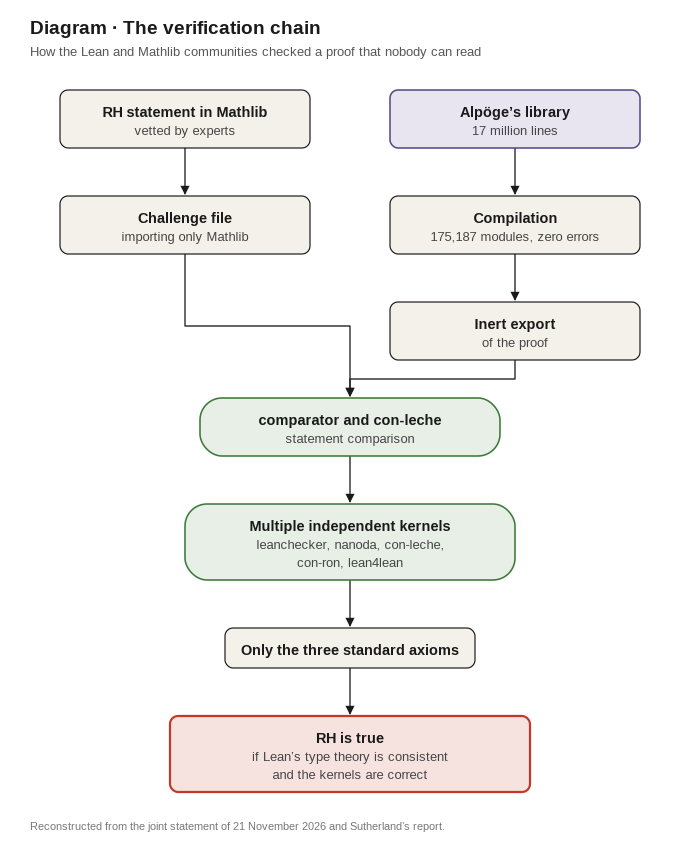
On November 12, eight days before the announcement, Kevin Buzzard had published a post on his blog that now seems written on purpose. It was a response to OpenAI’s October release, in which about 45% of the 722 papers came with Lean code. Buzzard documented that 38 of the 290 papers with Lean code did not state the main theorem, and that three papers without Lean had been retracted because of a sign error. His thesis was that the phrase “it’s true because it’s verified in Lean” can work, but only after answering four questions.
- Does the Lean statement match the informal statement? Lean separates the statement of a theorem from its proof, and you can perfectly well prove a wrong statement. Buzzard shows a “Fermat’s Last Theorem” that compiles and is trivially false, because in Lean the natural numbers include zero.
- Does the code compile? For Fermat in Lean you needed a server with 96 cores and 500 GB of memory, plus an isolated environment, because AI-generated code can do unpleasant things to the machine that runs it.
- Does the proof really prove the stated statement? Millions of lines can hide redefinitions of symbols or additional axioms, such as an axiom that simply asserts the claim. This is why the tool
comparatorexists: it compares the trusted statement with what the code actually proves and checks which axioms are used. - Does the code exploit a kernel bug? The Lean kernel has had correctness bugs, quickly fixed. Today there are several independently written kernels, one of which is formally verified down to assembly, and a proof can be submitted to all of them.
5.2 What was verified
The answers arrived in less than thirty-six hours. Andrew Sutherland of MIT was the first to compile the library, shortly before noon on November 20, followed by Simon DeDeo and dozens of others. His public report contains the technical details.
| Check | Result |
|---|---|
| Modules compiled | 175,187 out of 175,187, zero errors (Lean and Mathlib v4.33.1) |
| Independent recompilation in a sandbox with no network | Byte-for-byte identical export (about 61.6 GB) |
| Axioms used by the five main theorems | Only propext, Classical.choice, Quot.sound |
Replay with the official kernel leanchecker |
Passed on all modules |
nanoda (independent kernel in Rust) |
Accepts the whole export |
con-leche and con-ron in comparison mode |
Both accept, all five theorems justified |
lean4lean, module by module |
Passed |
| Requirements to repeat the checks | About 100 GB of RAM and 70 GB of disk |
On November 21, the Lean and Mathlib communities, with the endorsement of the Lean FRO and the Mathlib Initiative, published a joint statement. It certifies that the statement is the one in Mathlib, reviewed by experts in Lean and number theory, that the library compiles, that two independent tools confirm the correspondence between the proven theorem and the trusted statement, and that several checkers written in different languages accept the proof. The statement closes with a sentence that leaves no room for doubt: the communities say they have full confidence in the correctness of the proof.
5.3 What exactly was proven
Sutherland’s report lists five main theorems. The first is the Riemann hypothesis in its Mathlib form, the second is the same statement written out explicitly. The third says that for every modulus and every Dirichlet character modulo , primitive or not, we have for , with the sole exception of the trivial character at . The fourth and fifth state that every zero of a Dirichlet L-function in the critical strip has real part , in the general form and in the form for primitive characters, which is the usual formulation of GRH.
The report spells out a limit that many headlines ignored. The “GRH” that was proven concerns only Dirichlet L-functions. Dedekind zeta functions, Hecke L-functions and general automorphic L-functions are not covered.
By combining the proof with an independent formalization of Robin’s 1984 criterion, Sutherland then obtained two unconditional statements about the sum-of-divisors function . The first is the Robin inequality
the second is the Lagarias inequality
where is the -th harmonic number and is the Euler–Mascheroni constant. Until a few days ago, each was equivalent to the Riemann hypothesis. Today they are theorems.
5.4 A logical subtlety that strengthens the result
In the comments on Tao’s blog, someone asked whether a proof in Lean establishes the Riemann hypothesis in ordinary set theory, ZFC, too. It’s a fair question, because Lean’s type theory with the three standard axioms is stronger than ZFC. Mario Carneiro showed that it is equiconsistent with ZFC plus the existence of inaccessible cardinals, for every finite .
Whether the proof can be rewritten in plain ZFC is an open and technically interesting question. But there is an argument that makes the issue less troubling than it seems. The Lagarias inequality is equivalent to RH and has the form “for every , a certain property holds that can be checked with a finite computation.” In logic, we say that RH is equivalent to a statement. If a statement of this kind were false, there would be a concrete counterexample , and its falsity could be proven with a finite computation in any reasonable system, Lean included. Lean would then prove both the statement and its negation, and would be inconsistent. It follows that
In other words, to doubt the truth of the Riemann hypothesis today, you have to doubt the consistency of set theory with inaccessible cardinals, or the simultaneous correctness of several independently written kernels. That is a stronger guarantee than the one we have for most of the theorems we use every day, which rest on the careful reading of a few referees.
On this point it is worth being clear, because the temptation in a critical article would be to insinuate that “maybe it’s wrong.” Almost certainly it isn’t. The problem lies elsewhere, and the next section begins to show it.
6. Inside the box, as far as we can see
6.1 The sources for looking inside
To understand how the proof works, we have three sources today, none of them satisfying. There is Alpöge’s sketch, which he himself warns is partly paraphrased from Claude’s summaries and may be imprecise, and which Andrew Granville called “confused” and Radziwiłł called full of meaningless claims. There is Tao’s first reading, according to which the argument seems to use the full power of modern developments in the Langlands program and in arithmetic geometry. And there is a preliminary note by Robin Zhang of the IHES, dated November 21, which attempts to reconstruct the logical chain and states openly that from the second section onward it was largely written by an artificial intelligence.
This is already a fact worth noting. The first human map of a proof generated by a machine was largely written by another machine.
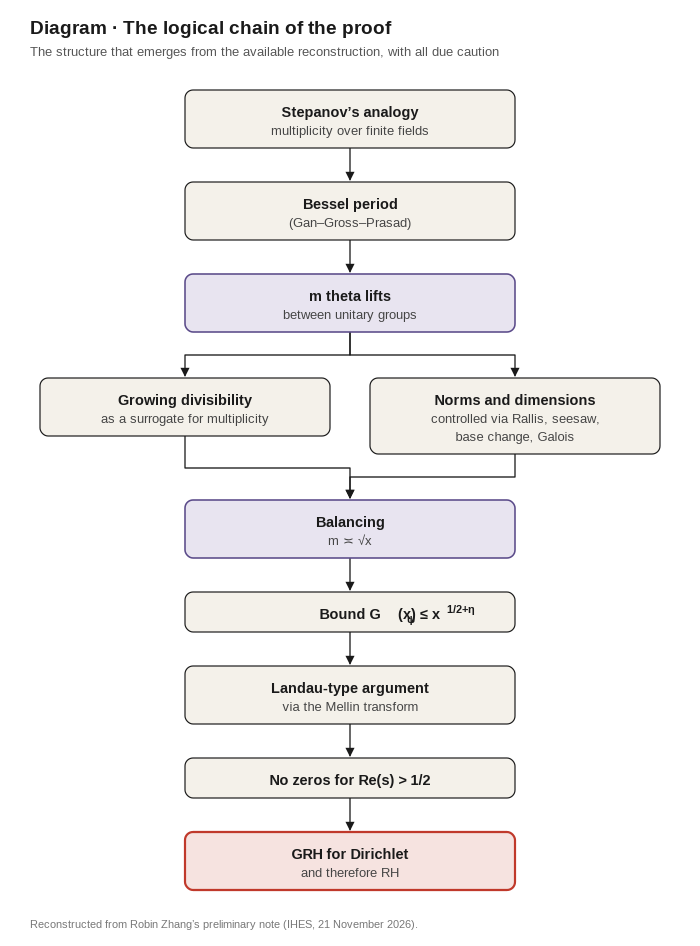
6.2 The logical chain, according to the available reconstruction
With all due caution, the structure that emerges is this. It starts from Riesz-type weighted sums over primes, associated with a character ,
where is the von Mangoldt function. Their Mellin transform is essentially , so it has poles exactly at the zeros of . One corrects these sums by removing the contribution of the pole at , obtaining functions , and considers a combination of them with positive coefficients , built on a character and its powers. The positivity is there to keep zeros shared by several L-functions from canceling each other out.
The decisive step is an upper bound of the form
valid on arbitrarily distant intervals. A Landau-type argument, based on the Mellin transform, turns an estimate of this kind into the absence of zeros to the right of the line . Letting tend to zero and using the functional equation for the left half of the strip, one arrives at GRH.
All the difficulty, of course, lies in proving that estimate, and this is where the analogy with Stepanov comes in. Over the integers there is no such thing as the multiplicity of a zero of a polynomial, and the proof replaces it with an object from representation theory. It starts from an automorphic Bessel period, in the sense of Gan–Gross–Prasad, and subjects it to a chain of theta lifts iterated times between definite unitary groups. Each lift increases the divisibility of certain arithmetic quantities, which plays the role of multiplicity in Stepanov’s method, but it also alters the norms and the dimensions involved. Kudla’s seesaw identities connect the initial period to the final one, the formulas of Rallis and of Gan–Qiu–Takeda express the norms of the lifts through values of L-functions, and base change to , together with the associated Galois representations (Clozel, Kottwitz, Harris–Taylor, Shin, Chenevier–Harris), makes it possible to control the local parameters. To keep the denominators under control, the proof draws on Galois cohomology, Iwasawa theory with the Ferrero–Washington theorem, and arguments from Arakelov geometry on the slopes of Hermitian lattices. There is even an adaptation of Behrend’s construction of sets with no three-term arithmetic progressions.
6.3 Where a half comes from
There is one detail that even a non-specialist can appreciate, and that Alpöge himself points to as the thing that struck him most: it was Claude who suggested a chain of length about . In Zhang’s reconstruction, the exponent comes from an elementary balancing act. Iterating lifts produces two errors of opposite sign, one that decreases like and one that grows like . The total error
is smallest when the two terms are equal, that is, for , and at that point it equals . In this proof, the critical line emerges as the equilibrium point of a compromise between two errors, exactly as in Stepanov’s method the error emerges from the compromise between the degree of the auxiliary polynomial and the multiplicity of the zeros.
It is a beautiful picture, and it is also, for now, almost everything we can say we have understood.
6.4 What remains obscure
Zhang’s note itself lists the points that require human verification. The estimate holds only on intervals of the form and not for all large , and we need to understand why this is enough. The analogies with Stepanov, Turán and Behrend must be turned into precise statements. The note also mentions a dependence on an enormous body of deep theory, with possible conjectural inputs in some cases. This claim should be read with caution, because the Lean code contains no additional hypotheses, so any such input, if there is one, must have been proved inside the library. And that is exactly the point. To know how much new mathematics those 17 million lines contain, how much is the formalization of known theorems and how much is original construction, we would have to read them, and nobody can.
Buzzard told Al Jazeera that right now we don’t even know why the theorem is true. He added that he expects to understand the code within a few weeks. Lamzouri spoke of months or years. Tao wrote that digestion will take time, noting that at least there is a human author to ask questions of. On how long it will take, opinions differ. On the fact that the work of understanding has yet to begin, everyone agrees.
7. Anatomy of a cognitive debt
7.1 Where the metaphor comes from
In 1992 Ward Cunningham introduced the term technical debt to describe a phenomenon that anyone who works in software knows well. You ship code that works but that is not fully understood or properly structured, and so you take on a debt. As long as the code runs, the debt stays invisible. But every time you have to modify it, extend it or fix it, you pay interest in the form of time, bugs and effort, and if the debt is never repaid, the system turns into a box that nobody dares to touch anymore.
In 2025 a group at the MIT Media Lab used the term cognitive debt in a widely discussed study, Your Brain on ChatGPT, to describe what happens to individuals when they systematically delegate writing and reasoning to a language model. People produced acceptable texts, but remembered little of them and internalized even less.
I propose using the same term on a different scale. I call cognitive debt of a community the distance between what it knows to be true and what it is able to understand. In a slightly playful way, but not too much, we could write
where is the set of results verified at time and is the set of results understood, meaning explainable, teachable and reusable by the people working in the field. For most of the history of mathematics the two sets grew together, because the main way to verify a proof was to understand it. Automated formal verification has pulled the two curves apart, and on November 20 the gap reached the largest value ever recorded for a problem of this importance.
7.2 A taxonomy of the 2026 cases
2026 offers an almost laboratory-like sample, with cases covering the whole range.
| Case | What the machine did | Size of the object | Cognitive debt |
|---|---|---|---|
| Jacobian conjecture (July) | Found a counterexample | A few lines, checkable by hand | None. Geometric explanation found within a few days |
| Zeros on the critical line, 67% (August) | Improved a known method | Readable paper plus Lean | Low. Taken up and simplified by several human groups within weeks |
| Fermat in Lean (September) | Formalized a known proof | 13 million lines | Already paid by Wiles in 1995 |
| Quasi-Riemann hypothesis (October) | Proved a new result | 49 or 199 pages | Moderate. Readable but poorly written, being absorbed |
| Riemann hypothesis (November) | Proved the problem itself | 17 million lines, more than 250,000 unpublished pages | Maximum. No one, the author included, understands its ideas |
The table shows that the use of artificial intelligence in mathematics can generate very different cognitive debts, and that their size depends on the type of object produced and above all on how compressible it is. A counterexample of a few lines carries its own explanation with it, or at least makes it easy to find. An existential proof of millions of steps does not.
7.3 Verifying and understanding are different axes
The history of mathematics already knows cases where verification and understanding came apart, though never to this extent.
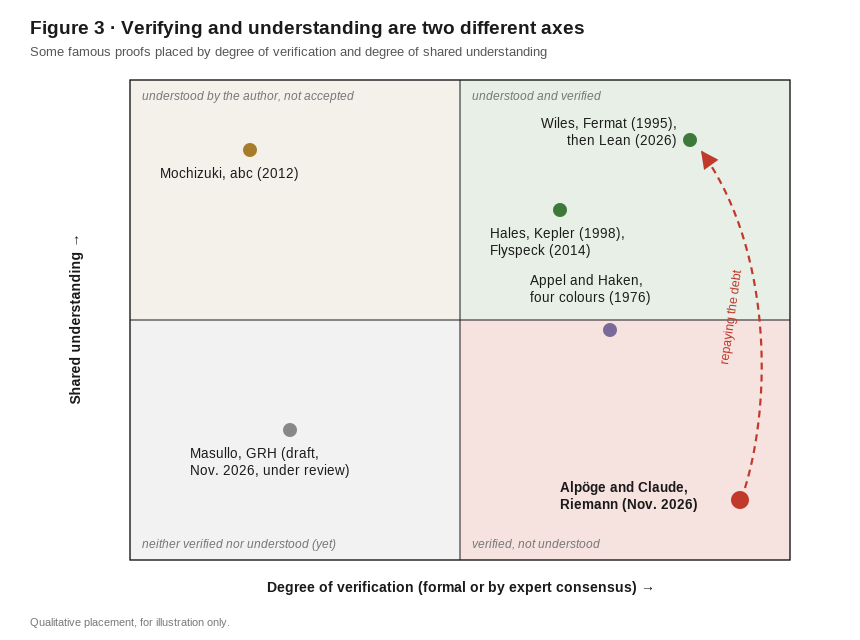
In 1976 Appel and Haken proved the four color theorem by reducing it to a computer check of almost two thousand configurations. For years many mathematicians refused to consider it a proof in the full sense, and the debt was only partly repaid, with the simplification by Robertson, Sanders, Seymour and Thomas in 1996 and Gonthier’s formalization in Coq in 2005. Even today no one can explain conceptually why four colors are enough.
In 1998 Thomas Hales presented his proof of the Kepler conjecture on sphere packing, with a computational part so extensive that the referees of the Annals said they were 99% certain of it, and could not go further. Hales responded by starting the Flyspeck project, which completed the formal verification in 2014. In that case the understanding of the ideas was there, and certainty was missing.
In 2012 Shinichi Mochizuki announced a proof of the abc conjecture based on his inter-universal Teichmüller theory. It is the mirror image of today’s case. The author claimed to understand his own ideas perfectly, but the community could not verify them. In 2018 Scholze and Stix identified what they considered a substantial error, and the proof has not been accepted by most experts.
Alpöge’s proof sits in the quadrant opposite Mochizuki’s. There we had the declared understanding of a single person and no verification. Here we have an almost incontestable collective verification and no understanding. The path ahead runs from the bottom-right quadrant to the top-right one, and that path is the repayment of the debt.
7.4 The principal
The principal of the debt is the understanding that was not produced along with the proof. In mathematics a proof establishes that something is true and, above all, shows why it is. It also serves to introduce concepts and techniques that then migrate to other problems, and to change the way a generation of researchers thinks about an entire territory. Along with Fermat, Wiles’s proof gave us the modularity of semistable elliptic curves, later extended to all curves by Breuil, Conrad, Diamond and Taylor, and a huge piece of the Langlands program, which in turn has fueled decades of research.
If Alpöge’s proof really contains a new way of producing multiplicity over the integers through theta lifts, that idea could be worth more than the Riemann hypothesis itself. It could open the way to the extended hypothesis, to the grand one, to problems we cannot even formulate today. But as long as it stays buried in 17 million lines, that value is frozen. It is capital that exists only on paper, or rather only in code.
7.5 The interest
The interest is paid in human time, and it is paid by people who did not take on the debt. It is paid by the mathematicians who in the coming months will spend weeks reconstructing an argument that no one wrote for them. It is paid by the PhD students who will have to decide whether to work on problems a machine might solve tomorrow. It is paid by the referees who will receive papers built on this result without being able to check its conceptual foundations.
Juliette Bruce, commenting on Tao’s blog, recalled a warning from Tao himself about the opportunity cost of turning great problems into social media announcements. It is a less obvious but real form of interest. Every hour spent deciphering a black box is an hour taken away from other mathematics, and when black boxes arrive at the pace of 722 papers in a single day, the community does not have the resources to open them all.
Then there is compound interest, which is the most insidious part. Results that have been verified but not understood will be used as bricks for other results. Every theorem that rests on RH, and there are hundreds, now becomes unconditional, but our understanding of it hangs on a link that nobody can explain. Debt propagates along the dependency graph exactly as technical debt propagates along the dependencies of a piece of software.
7.6 Who holds the credit
With technical debt, it is clear who the creditor is. It is the future of the same organization that wrote the code. With today’s cognitive debt the geography is more complicated and more worrying.
Almost all of this year’s results came from private labs with access to internal models, not available to the community. The model Alpöge used was never named. Tao simply describes it as an internal model. We don’t know how much compute it took, which prompts were used, how many paths were abandoned. Buzzard has observed that the great discoveries of this period are concentrated in the tech companies that have the best models. Even rerunning the checks requires machines with around a hundred gigabytes of memory, which the average mathematics department doesn’t have.
There is one more layer, almost ironic. Sutherland’s verification report was produced, as he states himself, by running the checks with Claude Code. The first human reconstruction of the method was largely written by an artificial intelligence. The errors in Masullo’s human draft were found with the help of language models. We are using the tools that generated the debt to manage it as well. This is not bad in itself, but it means the debt is being refinanced with the same creditor.
7.7 The risk of default
What happens if the debt is never repaid? If in ten years Alpöge’s proof were still a library of millions of lines that nobody can explain, we would have a true theorem that is useless as a source of ideas. We would use it the way one uses an oracle, citing it without understanding it. And number theory would have lost the very thing that for a century and a half made the Riemann hypothesis so precious: the promise that its proof would teach us something deep about the prime numbers.
I don’t think it will go that way, and Conrey told AFP he is convinced simpler ways will exist. But the risk is real, and it grows with the number of results produced in this manner. One incomprehensible proof can be digested. A hundred incomprehensible proofs a year cannot.
8. What mathematics is for
We come to the question that gives meaning to everything else. If a statement is true, and a machine has verified it more reliably than any referee could have, what is missing?
William Thurston, in a 1994 essay titled On proof and progress in mathematics, argued that the goal of mathematics is to advance human understanding, and that theorems are a tool for measuring that understanding rather than its end. Radziwiłł told Quanta something very similar about Alpöge’s proof, observing that the object of mathematics, like that of the other sciences, is the question “why?”, and that this proof does not answer it at all.
The statement signed in September by 25 Fields medalists, including Tao, Scholze, Viazovska, Maynard and Bhargava, points in the same direction. The text, titled A Severe Misalignment of AI in Mathematics, acknowledges that language models are now able to solve important problems in many fields, but maintains that the purpose of the discipline is to advance the conceptual understanding of those who practice it, and that the mass production of AI-generated proofs puts that culture at risk. The misalignment in the title concerns objective functions. The labs measure progress in problems solved; mathematics measures it in understanding gained.
Among the signatories is Manjul Bhargava, who was Alpöge’s doctoral advisor. I mention it with no intention of hinting at a personal conflict, which I know nothing about and have no interest in discussing, because the coincidence makes the rift running through the discipline today visible in an almost theatrical way. Two generations of the same school, both of the highest caliber, find themselves on opposite sides of a question that until a few years ago nobody was asking.
There is another image that helps. Erdős spoke of the “Book,” an imaginary volume in which God keeps the most elegant proofs of every theorem, the ones that make you understand everything in a few lines. Alpöge’s proof is, for now, the exact opposite of a proof from the Book. It is true, but it is 250,000 pages long. For a mathematician, the difference between a proof from the Book and a true proof is the difference between knowing and understanding.
One could object that this is a romantic position, and that science has long accepted results that no human being understands in detail. Physics uses numerical simulations that nobody checks by hand, and engineering trusts verification software that nobody reads. That’s true. But in physics and engineering, understanding lives elsewhere, in the models and the principles you start from, and computation is a means. In pure mathematics the proof is the very place where understanding happens. Taking understanding out of a proof is like taking away mathematics’ reason for being.
Buzzard rejects the idea that artificial intelligence has made mathematicians obsolete, and compares it to a telescope. I like the image, but it has to be taken seriously all the way. Galileo’s telescope revealed the moons of Jupiter, and it took Kepler and Newton, decades later, to understand why they moved the way they did. If artificial intelligence is a telescope, we have just seen something extraordinary, and the work of understanding what we have seen lies entirely ahead of us.
9. Where we need to be tough
So far I have tried to describe. Now I want to say clearly what, in this story, seems wrong to me, or at least dangerous. I do it with respect for Alpöge, who is an excellent mathematician and who, in his note, was more honest than company press releases usually are, but without indulgence for the system in which this story unfolded.
9.1 The timing
Anthropic went public on the Nasdaq on November 19, in what has been described as the largest initial public offering in history. The next day one of its employees announced the solution of the most famous problem in mathematics, obtained with the company’s main product. Granville told Nature that Alpöge should have prepared an intelligible exposition before announcing, and he linked the timing to the performance of the stock.
Alpöge anticipated the criticism in the note itself. He wrote that there is an obvious cynical reading of the timing and that it is false, he called the moment horrible, and he said that he obtained the result on Sunday evening and consulted with Dario Amodei on how to communicate it. Anthropic did not respond to requests for comment from AP and AFP.
I have no reason to doubt Alpöge’s good faith, and I don’t want to. The problem I see concerns the structure in which he found himself working. When the most important mathematical results of the century are produced inside publicly traded companies, every scientific announcement also becomes a market event, regardless of the intentions of whoever makes it. Mathematics has always had its own pace, made of preprints, seminars, months of verification and years of peer review. Markets have a different pace, and when the two timescales overlap, it is mathematics that loses. An announcement made with four “confusing” pages and seventeen million lines of code is an announcement made at the speed of the market, even if its author doesn’t want it to be.
9.2 The hidden process
We know a great deal about the result and almost nothing about the process. We don’t know which model was used, or how much compute, or which prompts, or how many interactions, or how much Alpöge corrected, selected and steered. The physicist Tony Padilla asked France 24 that Alpöge make the path public. Several commenters on Tao’s blog criticized the lack of transparency on these points.
This is not curiosity. Without the process, it is impossible to assign credit, impossible to assess how reproducible the result is, impossible to understand which part was the human contribution and which the machine’s. Abhishek Saha argued to Al Jazeera that the credit should go mostly to Alpöge and that he deserves the Fields Medal. Alpöge, on the contrary, attributes the decisive part of the final phase to Claude. Are they both right? Neither? Without a record of the work, we will never know. Last August, together with the 67% result, Anthropic had also published the transcripts of the process. For the most important result, instead, there is no process.
It should be said that the choice not to publish the 250,000 pages is understandable and even commendable. Alpöge preferred not to dump a mountain of generated, unchecked text on the community. But the consequence is that the community receives an object it can verify and cannot read, which is exactly the object with the highest possible cognitive debt.
9.3 A race with casualties
Masullo’s story is the bitterest part of this affair. A young mathematician works for twelve years on a proof. His advisor, one of the greatest number theorists in the world, has been reading it line by line for months. The plan is to give him a year to polish the text, as has always been done with important work. Then, in a single afternoon, a company’s announcement forces the president of the AMS to publish a 940-page draft that still contains placeholders, a few hours before a meeting, with a post literally titled “hasty announcement.” Within a few hours the draft is being dissected by people who use language models to find its errors.
Masullo’s proof may be wrong. It may be right, and the problems that have been flagged may be fixable. Tao observed that his approach is closer to Deninger’s strategy than to Connes’s. However it turns out, it was exposed in the worst possible way, at the worst possible moment, and the reason is that human mathematics felt forced to take part in a race it had not chosen.
This is a side effect that nobody had taken into account and that will happen again. If every big problem can be solved by a machine at any moment, those who have worked on a problem for years will be pushed to publish quickly, before being overtaken, and the quality of human work will suffer. The race to announce, which the labs treat as a measure of their models’ progress, offloads its costs onto the most fragile people in the community: young researchers who don’t yet have a stable position.
9.4 The concentration
I’ve already mentioned that almost all of this year’s results come from private labs. I want to insist on it, because it is the most important point politically. For the first time in modern history, the frontier of pure mathematics has moved from universities to a small number of companies that have models the public cannot access and computing resources no department can afford.
In September OpenAI announced, with an internal model, the solution of the forced version of the Navier–Stokes problem, and two weeks later it declared that it had solved more than a hundred other open problems, without publishing either the list or the proofs. The Navier–Stokes case then sparked a priority dispute with Tristan Buckmaster and Alpöge himself. The October release poured 722 papers onto the community in a single day. The proof of Riemann comes from a model whose name we don’t know.
Mathematics has always rested on a principle of radical openness. Anyone with paper, pen and enough talent could check any result. Today, checking a result requires a server, understanding it may require a model that only the company owns, and reproducing it may be impossible for anyone else. The cognitive debt adds to a debt of access, and together they risk turning the mathematical community into an audience watching results produced elsewhere.
9.5 The language of headlines
Finally, a note on journalism, which in these days has done much better than I feared, though not always. In the first hours, some headlines took the proof as accepted, others took it as unverified when verification was already under way, and almost all of them spoke generically of the “generalized Riemann hypothesis” without specifying that this is only the Dirichlet case. An article in Scientific American ran a headline saying the proof is true and confirmed by independent mathematicians, when what has been confirmed is its formal correctness. The Clay Institute still lists the problem as unsolved, and its rules require publication in a peer-reviewed journal and a two-year period of scrutiny by the community. A Lean library is not a publication.
These distinctions may seem pedantic, but they are exactly the ones on which the meaning of this story depends. “It is true” and “we have understood it” are two different statements, and journalism that confuses them helps increase the debt, because it makes the public believe the work is finished when it has barely begun.
10. What really changes
So as not to fall into the opposite error, that of downplaying, it is worth taking stock of what this proof concretely changes.
Hundreds of conditional theorems become unconditional. All the results of the form “assuming GRH for Dirichlet L-functions” are now theorems. The Robin and Lagarias inequalities, as we have seen, were formally deduced within a day.
Some algorithms gain rigorous guarantees. In 1976 Gary Miller proved that, assuming GRH, his primality test is deterministic and runs in polynomial time. Today this guarantee is unconditional. It should be said that since 2002 the AKS test has existed, deterministic and polynomial without any hypothesis, so the novelty is more theoretical than practical.
Cryptography doesn’t change. This is one of the most widespread myths, and it is false. The security of RSA rests on the difficulty of factoring large integers, and the truth or falsity of the Riemann hypothesis doesn’t touch it. The proof confirms a hypothesis that cryptographers already took to be true, and it provides no factoring algorithm. Buzzard recalled that cryptography has long assumed the hypothesis to be true, and in fact his proof strengthens some guarantees instead of weakening them.
The stronger versions remain open. The extended hypothesis for Dedekind zeta functions and the grand hypothesis for all automorphic L-functions have not been proved. Buzzard said that the Riemann hypothesis sits at the foot of a mountain. If the method extends, as Alpöge expects, the mountain could be climbed soon. If it doesn’t, we will have proved the most famous case without having understood the general phenomenon.
The Clay prize won’t be awarded anytime soon. The rules require publication in an internationally prestigious journal and at least two years of acceptance by the community, so no payment is possible in 2026. Then there will be the unprecedented question of how to award a prize for a proof written largely by a machine. For forced Navier–Stokes, in September, Clay stated that the problem seemed to be solved and that the evaluation would be deliberately unhurried.
11. How to repay a debt
If the diagnosis is correct, rejecting artificial intelligence would be impossible as well as foolish, and the cure must be sought in building institutions, norms and tools that put understanding back at the center. I’ll try to suggest a few.
A readable exposition as a condition of the announcement. The mathematical community could adopt a simple norm. A result on a major problem is announced when there is a text that an expert in the field can read in a reasonable amount of time, and code that compiles is not enough on its own. Granville put it bluntly, but he is right. A norm like this leaves everyone free and merely establishes what the community considers a contribution.
Transparency about the process. The model used, the computing employed, the prompts, the log of interactions, the abandoned paths. Anthropic did this in August for the result on the 67%, and did it for Fermat. It should become the rule, especially for the most important results, and journals could require it just as they already require data availability in the experimental sciences.
Tools to translate from the formal to the informal, with caution. Buzzard points out that some experts already use AI to translate Lean code back into English or Italian, instead of reading the attached PDF. It is a promising road, but a paper from October with the telling title Navier–Stokes lost in translation documents how far the text and the code can diverge. We need tools that can guarantee the two versions correspond. The mere plausibility of the generated text is not enough.
Rewarding exposition. If a mathematician’s value is measured in problems solved, and machines solve them better, the profession is bound to shrink. If it is measured in the ability to understand, explain and connect, the work to be done is enormous and will remain so for decades. Universities, journals and funding bodies should recognize as first-class contributions the simplification, the conceptual rewriting and the explanation of existing results, including those generated by a machine.
Slowing down. This is the hardest proposal, because it runs against everything the market asks for. But the statement by the Fields medalists says it plainly: mathematics needs time to digest. A lab that releases 722 papers in a single day contributes no more to mathematics than one that releases a single paper, well written and explained all the way through. Probably it contributes less.
Teaching the difference. Those of us who, like me, teach and work with these tools every day have a particular responsibility. We must teach students that knowing something is true and understanding why it is true are two different achievements, and that the second is what makes a person able to do something new. If we don’t, cognitive debt will stop being a phenomenon of the mathematical community and will become, as the MIT study suggested, a phenomenon of each one of us.
Epilogue
Siegel spent years deciphering Riemann’s notes, and when he succeeded, mathematics gained a formula that we still use today to compute the zeros of the zeta function. That debt was repaid by a human being who had the talent and the patience to reconstruct the thinking of another human being.
The debt we took on on November 20 is of a different nature. The thinking to be reconstructed belongs to a system, and perhaps it does not match what we usually call thinking. It looks more like a trace left by a system that explored a space of possibilities larger than any human mind can travel, and that found a path to the summit. Now we know the path exists and that it leads to the top. We do not yet know what it saw along the way.
I believe we will find out. I believe that in a few years there will be a proof of the Riemann hypothesis a few hundred pages long, written by human beings, perhaps with the help of machines, which will explain how theta lifts replace multiplicity and why the critical line emerges from a balance between two errors. On that day we will be able to say we solved the Riemann hypothesis in the sense in which Riemann would have meant it.
Until then we have a true theorem and an open debt. And the most important thing to remember is that mathematics exists to help us understand, and that no verification, however perfect, relieves us of that task.
Sources
Primary sources
- Levent Alpöge, Remark, note of November 20, 2026. alpo.ge/remark.pdf
- Lean and Mathlib communities, Lean verification of the Riemann Hypothesis, joint statement, November 21, 2026. leanprover-community.github.io
- Andrew Sutherland, Report: Lean verification of the Riemann Hypothesis proof, MIT. math.mit.edu/~drew/grh
- Robin Zhang, A preliminary note on Alpöge’s proposed proof of the Generalized Riemann Hypothesis, IHES, November 21, 2026. ihes.fr
- Kevin Buzzard, …and the proof is checked in Lean, Xena Project, November 12, 2026. xenaproject.wordpress.com
- Terence Tao, Unforced Euler singularity, unforced Navier-Stokes singularity, and the Generalized Riemann Hypothesis, November 20, 2026. terrytao.wordpress.com
- Ravi Vakil, Hurried Announcement: Alessandro Masullo GRH, Math 216 blog, November 20, 2026.
- Anthropic, Formalizing Fermat’s Last Theorem, September 4, 2026. anthropic.com
- Anthropic, Learning more about Claude’s mathematical capabilities, August 2026. anthropic.com
- A Severe Misalignment of AI in Mathematics, statement signed by 25 Fields medalists, September 11, 2026.
Press and analysis
- Quanta Magazine, As mathematicians race to verify AI Riemann proof, a human proof emerges, November 20, 2026.
- Quanta Magazine, AI Proved the Quasi-Riemann Hypothesis. What Happens Now?, October 19, 2026.
- Nature, Mathematicians astounded by AI and human-written proofs of iconic Riemann hypothesis, November 2026.
- Science, AI may have solved math’s greatest mystery. Can humans understand the answer?, November 2026.
- Al Jazeera, Riemann hypothesis: Has the world’s most famous maths problem been cracked?, November 21, 2026.
- IBM Think, Anthropic mathematician claims AI helped solve a 167-year-old math mystery, November 2026.
- AFP, dispatches of November 20–21, 2026 with statements by Brian Conrey.
- Scientific American, articles of November 20–21, 2026 on the Lean verification.
Historical and technical references
- B. Riemann, Ueber die Anzahl der Primzahlen unter einer gegebenen Grösse, 1859.
- C. L. Siegel, Über Riemanns Nachlaß zur analytischen Zahlentheorie, 1932.
- W. P. Thurston, On proof and progress in mathematics, Bulletin of the AMS, 1994.
- W. Cunningham, The WyCash Portfolio Management System, OOPSLA 1992 (origin of the expression “technical debt”).
- N. Kosmyna et al., Your Brain on ChatGPT: Accumulation of Cognitive Debt when Using an AI Assistant for Essay Writing Task, MIT Media Lab, 2025.
- M. Carneiro, The Type Theory of Lean, 2019 (equiconsistency with ZFC plus inaccessible cardinals).


